
Interview: In conversation with Alex Physalis: control and chaos
Featuring Alex Physalis
Alex Physalis discusses sound design, neurobreaks, and creative independence, alongside releases on Renegade Hardware and his High Tree Records imprint.
There is a certain tension in Alex Physalis’ music. Precise, almost clinical at times, then suddenly loose, unpredictable, slightly off-centre. It makes more sense when you hear him talk. We caught up with Alex Physalis around his work with Renegade Hardware, and the thinking behind a sound that refuses to sit comfortably in one lane.
When you sit down to start something new, what tends to spark it: a specific bass tone you have sculpted, a break you have twisted beyond recognition, or just a mood you are trying to pin down?
The base I start building a track with is the synthesis of the kick and snare – either synthesis or a selection from my own library. Then this framework gets fleshed out with rhythm, bass, melody, intro, and so on.
You spent years operating as Dread before stepping forward under your own name. What changed creatively when you made that shift? Was it a clean break, or more of a gradual evolution?
Throughout my music career, I've probably changed aliases 5-6 times. The transition from Dread to Alex Physalis was both abrupt and lengthy. I didn't release new music for about 8 years; during that time, I experimented a lot, and I wrote music for various videos and commercials. I grew as a person, very serious changes happened in my life – I completely gave up drugs, alcohol, and cigarettes. I changed my lifestyle and got into spiritual practices. That person essentially disappeared, and on the ruins of the old personality, a completely new one grew. And I decided to return to the music industry again. So it can't be called an evolution; it's a new project with a strong past background.
There is a precision to your sound design that feels almost architectural. Do you go in with a blueprint, or do you prefer discovering the final shape of a track as it unfolds?
When I sit down to write a new track, the only starting point is the tempo. That is, it's always a flow of creativity that comes from me and through me, but even the tempo can change during the process. That's how my release 'Metaphysics' came about. Initially, it was a technoid track, almost finished, but then I decided to change the tempo to 140 from 174, a couple of edits, and the track was completely different. That's how I burst onto the neurobreaks scene and immediately ended up on the pages of DJMag with my new, unique sound. It's almost always pure improvisation.
Renegade Hardware carries serious weight in darker drum and bass history. What did releasing there represent for you personally, given the label’s legacy?
Yes, it's probably great. I was listening to their releases even before I understood the significance of labels and such. I listened to Raiden – Falling; it was one of my favourite tracks. I didn't know the name Renegade Hardware back then; I just listened to the music. For me, it was probably expected that this label would pick up my music for release and that I would sign a contract with them. I don't really follow the rating system much, especially now when marketing means more than the product itself. But considering what this label has invested in the development of dark drum & bass, I'm glad they recognised my music. But actually, the main thing is that the artist loves the result of their work and values their own talent. Clichés are everywhere, yes, people read labels, but it's not important; the main thing is to create what you feel – a publisher and listeners will be found.
You have put a huge amount of time into sample pack development, including Quantum Breaks and Art of Neurobreaks. Does designing tools for other producers sharpen your own productions, or does it scratch a completely different creative itch?
Absolutely, it's my position to give something new that doesn't exist on the market, something I myself would have missed if I were looking for sample packs or synth presets. Lenny Dee initially brought me into this business; I joined Industrial Strength and began creating sample packs intensively. The motivation was insane. My very first sample pack became a bestseller on Loopmasters, as did many subsequent ones. I immediately ended up in the pages of respected magazines like Future Music and Computer Music, getting rave reviews and awards. At that time, no one from Belarus was doing such things in the Drum & Bass scene, or really at all. That 24-year-old me was thrilled. I also worked with Zenhiser, Function Loops, Sharp, Diginoize, and others. I always try to push a new sound. Nowadays, my new packs are without analog. The Quantum Breaks sample pack, which I released on commission for Big Fish Audio, became an absolute bestseller across the entire Big Fish platform. Within two days of release, it became the best-selling pack on the site across all labels and genres, and it stayed at number one for a month and a half. For such an underground genre as neurobreaks, it was a real breakthrough. Same with my pack, Art of Neurobreaks, which I released on my own label; it also topped the sales charts on various platforms. These are the first neurobreaks sample packs in the world to be released on major platforms.
Neurobreaks sits slightly outside the mainstream drum and bass conversation. What keeps you committed to developing that sound rather than leaning fully into a more conventional 174 framework?
Yes, Neurobreaks is a separate genre from breakbeat and drum & bass. It's a hybrid, just like Crossbreed DnB, Technoid, etc., appeared back in the day. I develop this sound because it's interesting to me. I'm one of the frontmen of the genre, and I understand that I have a responsibility, in part, for the direction the genre takes. I'm multi-genre, and while developing this genre, I continue to devote a huge amount of attention to the dark side of drum & bass. In every one of my tracks, you'll hear my signature sound. I don't follow fashion or trends; I make the music I want to listen to myself. After all, my favourite musical artist is myself, and I make exactly what I want to hear. Imagine you know how to make really cool cakes (I can imagine, I'm a co-owner of a confectionery business). And at any moment, you can take and eat exactly the dessert you want, and you know how to make it from the best ingredients, you have the skills. That's how it is with me and music. I rarely listen to other people's music, only if producer friends ask me to give feedback on their work, or occasionally demos for High Tree. I often have musical detoxes; I don't listen to other people's music for months and try to forget it as much as possible. I do this to clear my (my own concept and definition) creative clusters. A human, as a being, tends to repeat what they like. And after listening to a track where you liked even just one element, you'll unconsciously try to repeat it or interpret it differently in your own work. So I put myself through months without other people's music. I listen to my own music and draw inspiration from my own tracks. It doesn't always work perfectly, but since my house is in the middle of a forest, I can go for weeks without seeing other people besides my wife; such isolation works well for me.
High Tree Records is active again. What kind of music feels right for that platform now, and does it give you something that releasing on established labels cannot?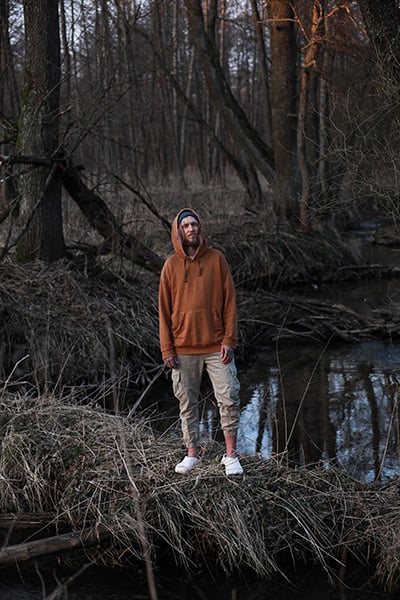
High Tree Records is first and foremost my own creative space. I relaunched the label for self-releases. But some friends of mine have joined as artists being released on it. Here, I release more original compositions, with more open genre boundaries and overall sound. Many labels want a specific sound, for example, like a tighter modern snare or a more trendy vibe in some tune. That often doesn't suit me, because what's trendy today will be outdated tomorrow. I don't work that way; I do what I feel, and listeners who share my sound will always be found. Before, during collaborations with other artists, I often encountered questions like: 'Why is there a key deviation in some parts of the track?' 'Why isn't the structure DJ-friendly?' 'Why isn't the tempo standard?' 'Why isn't the rhythm standard?' And so on. And it's because I'm fundamentally hit different. I know perfectly well the key I'm writing in – I have a musical education, I'm a saxophonist, I know academic harmony, I know jazz harmony. The deviations are intentional to give the composition liveliness. I do it so the track breathes, stumbles, not following rigid patterns, but like a living being. Inflection – that is life itself. And in today's world, where everything is too programmed and put into boxes, to breathe life into something, you need to create a little disorder. For example, there's always a huge mess in my projects, which is why I release so few collaborations. It's very hard for another person to read my project; even exporting stems is very difficult for me because my timeline is chaos. But at the same time, I know exactly where everything is. It's probably something mental, but I like it; it's comfortable for me.
Your visual identity is very much your own, and you create your cover artwork yourself. How important is that full control of the aesthetic world around the music?
I'm glad you appreciate my art, it's always nice to hear. Yes, I make the covers myself; exceptions are extremely rare. I can't always influence this if it's a compilation or a various artists release, but my mandatory condition for any label wanting to release my solo material is my own cover art. Because no one other than me can so accurately convey visually the aural aesthetic I want to present. I deliberately delved into 3D modelling and visual design for this purpose. I absolutely do not respect AI art. Art should be made by a human; it [AI art] is cheap generation, more for mass products, usual, non-unique. I'm convinced that those who use generative images or music are completely untalented individuals with not a drop of creativity and no respect for art in general. That sounds harsh, but that's how I feel.
You have been immersed in sound design for nearly two decades. Has your relationship with drum and bass changed over time? Do you still feel part of a movement, or more like you are carving your own path alongside it?
You know, I've always been both part of the movement and simultaneously an outsider, paving my own way. Essentially, I hold the position that if you walk down a beaten path, everything there will already be looted. Maybe it'll be easier to walk, but the result will be much more meagre. So I go my own way; some see it as quite strange, but it's entirely my path.
Looking ahead, are you more interested in refining the darker drum and bass edge of your sound, or pushing further into hybrid territory where genre lines blur?
It's hard for me to answer that question. Actually, yes, I will hone the dark side of drum & bass, and yes, I will move across genre boundaries, and combine one with the other. Focusing on just one genre is essentially very boring for me, so I constantly switch back and forth.
Finally, you’re stranded on a desert island with one turntable, a generator and one record. What’s it going to be?
I suppose it would be the record that burns the best and the longest. If I find myself on a deserted island – hypothetically, of course – I would 100% not be in the mood for music. I have experience surviving in the wild; I definitely wouldn't use the generator's power to listen to music. Art is only relevant when basic life needs are met. And it's truly wonderful that we live in a time when, through art, we can more than meet those needs.
Alex Physalis continues to operate in that in-between space, part of the drum and bass continuum, but rarely following its usual patterns. With releases tied to Renegade Hardware and his own High Tree Records, the focus stays firmly on control, disruption, and instinct, sometimes all within the same eight bars.